Product Details
ARDEX P 51
Primer and Bonding Agent
- Concentrate
- Reliable primer with a wide range of applications
- Primer, bonding agent and pore filler with water-repellent effect
- Prevents air bubbles from rising from the substrate during filling
- Solvent-free
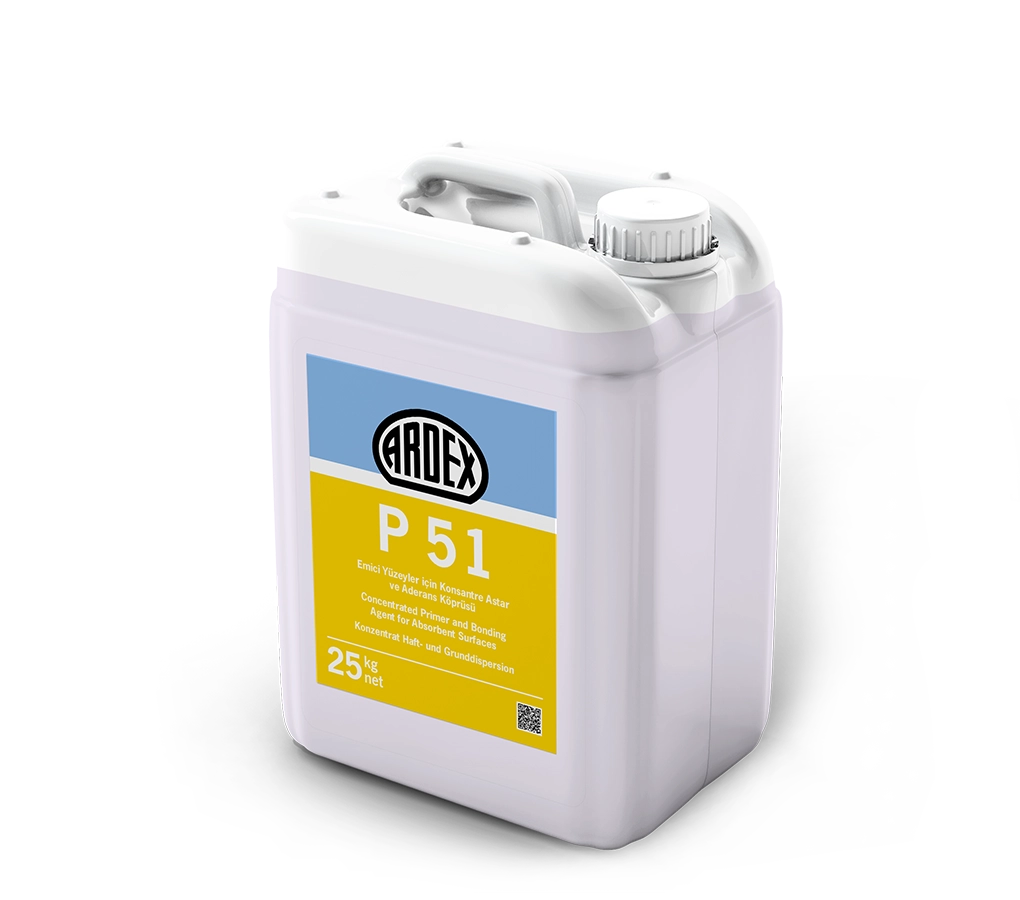
ARDEX P 51: Primer for Absorbent Surfaces
ARDEX P 51 is a versatile primer for indoor use, enhancing adhesion and sealing pores on floors, walls, and ceilings. It significantly reduces water absorption, prevents air bubbles in self-leveling applications, and is solvent-free. Suitable for various substrates including gypsum, concrete, terrazzo, and old screeds. Available in 10 kg and 25 kg canisters, it can be stored for 12 months in a frost-protected environment.
Description
Solvent-free synthetic resin dispersion which, after drying, significantly inhibits the penetration of water.
Use
Indoor use. Floors, walls and ceilings.
Priming, pre-coating, bonding agent and pore sealer with water-repellent effect.
For bonding powdery substrate surfaces, e.g. on sanded, absorbent calcium sulphate and calcium sulphate selflevelling screeds, for priming cement screeds, for accepting filling, levelling and smoothing compounds.
As a bonding agent on smooth concrete floors, particularly compacted cement screeds, modified calcium sulphate screeds, Terrazzo, sandstone, tiles and slab coverings when using levelling compounds and thin-bed mortars.
As a bonding agent on old substrates with adhering levelling compound and adhesive residues.
As a pore sealer on concrete floors and cement screeds
- prevents air bubbles from rising from the substrate during subsequent filling applications
- prevents mixing water from being knocked away during subsequent filling.
For priming gypsum, calcium sulphate and chipboard for thinbed concrete mortar.
As a bonding agent on smooth concrete for gypsum-based wall fillers.
Protective coating for dust binding on fillers and levelling compounds that are used as work surfaces for a short time.
Considerations
When applying to old substrates, ensure that the levelling compound and adhesive residues are waterproof, sufficiently load-bearing for future loads and adhere well to the substrate. Allow the primer film to dry overnight. Water-soluble levelling compound and adhesive residues (e.g. containing sulphite lye) must be completely removed.
For adhesive residues based on polyurethane, epoxy resin and bitumen, use ARDEX P 82 Synthetic Resin Primer as a bonding agent.
Coatings to be applied on existing ceramic, terrazzo, natural stone, PVC, etc. must be fully bonded to the substrate and must not be detached in any way. Before priming, the surface should be thoroughly cleaned with appropriate products (preferably Lithofin).
Packaging
10 kg or 25 kg plastic can
Shelf Life and Storage
Can be stored frost-free for approx. 12 months in the original sealed container.
Material Requirement
30 – 300 g/m² (according to the dilution ratio)
GHS/CLP Classification
none
GGVSEV/ADR Classification
none
IMPORTANT NOTE
This Frequently Asked Questions (FAQ) section is prepared for general information purposes and does not constitute a definitive guide. For the most accurate and up-to-date information please refer to the product technical data sheets. For detailed information about product features, usage conditions, and application methods, we recommend consulting the ARDEX Turkey technical team. Before any application, obtaining expert advice on surface preparation and product selection will increase the success of the application.
How can I prevent air bubbles in self-leveling floor applications?
To prevent air bubbles in self-leveling floor applications, use a primer like ARDEX P 51. It seals the pores and reduces the surface’s water absorption, preventing air bubbles from forming.
What primer should I use on concrete before applying plaster?
For concrete surfaces, use ARDEX P 51 as a primer. It enhances adhesion and provides a solid base for plaster applications, ensuring a smooth and durable finish.
How do I improve adhesion on old screeds before applying new floor coverings?
To improve adhesion on old screeds, apply ARDEX P 51 primer. It acts as an adhesion promoter and seals the surface, making it suitable for new floor coverings.
What can I do to reduce dust on plastered surfaces?
To reduce dust on plastered surfaces, apply ARDEX P 51. It prevents dusting and provides a clean, stable surface for further treatments or coatings.
How do I prepare a substrate for tile installation?
To prepare a substrate for tile installation, use ARDEX P 51 as a primer. It reduces water absorption and enhances adhesion, ensuring the tiles bond securely to the surface.
Can I use a primer on gypsum and chipboard surfaces before tiling?
Yes, ARDEX P 51 is suitable for gypsum and chipboard surfaces. It acts as a primer, reducing water absorption and providing a solid base for tiling or other coverings.
What is the best way to seal porous surfaces before applying self-leveling compounds?
To seal porous surfaces before applying self-leveling compounds, use ARDEX P 51. It effectively seals pores and reduces water absorption, ensuring a smooth and even application of self-leveling compounds.
How can I prevent moisture loss in mortar applications?
To prevent moisture loss in mortar applications, apply ARDEX P 51 primer. It reduces the water absorption of the substrate, maintaining the necessary moisture for proper curing and strength development.
What primer should I use on terrazzo or sandstone before plastering?
For terrazzo or sandstone surfaces, use ARDEX P 51 primer. It enhances adhesion and prepares the surface for plastering, ensuring a durable and long-lasting finish.
How do I ensure a solid bond between old and new concrete?
To ensure a solid bond between old and new concrete, apply ARDEX P 51 primer on the old concrete. It promotes adhesion and creates a strong bond, allowing the new concrete to adhere effectively.
Do you have any questions about this product?
You can ask your questions about this product by filling out our contact form.